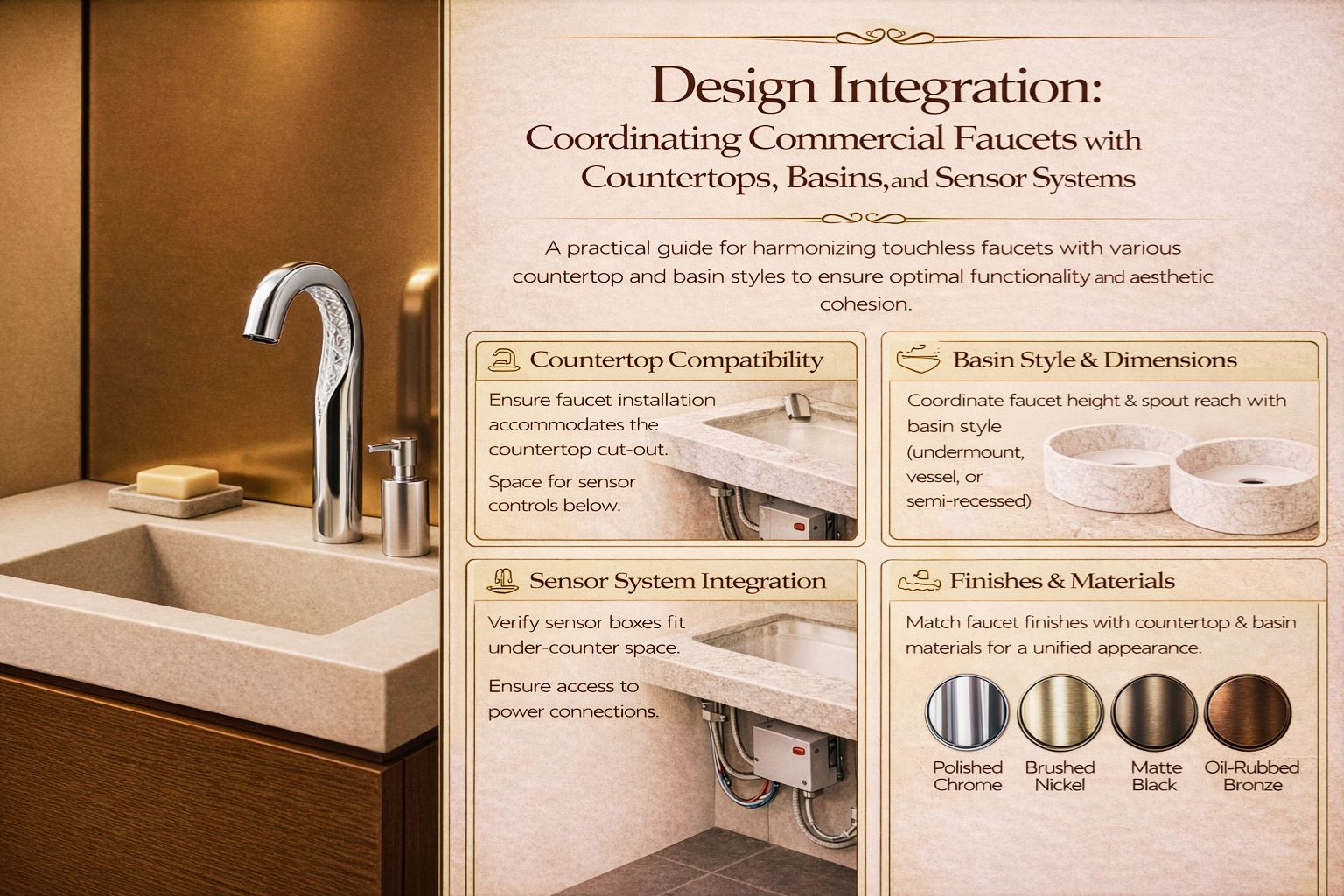
Commercial restrooms and amenity wash areas are where architecture, MEP coordination, and user experience collide. A faucet that looks right on a finish board can still splash, mis-trigger, or fail accessibility clearances when it meets the real countertop, basin geometry, and sensor control package. Good design integration is about planning the whole assembly so the water stream lands where it should, the controls are reachable, and the electronics are serviceable for years.
Below is a practical coordination guide for AEC teams. It focuses on faucet selection as a system decision, not a standalone fixture choice.
Start with the faucet, basin, and countertop as one assembly
A commercial lavatory setup has three interacting variables:
- Basin geometry (depth, slope, drain location, overflow, rim profile)
- Countertop thickness and edge condition (solid surface, stone, stainless, integrated bowl)
- Faucet geometry (spout height, spout reach, outlet type, mounting, control method)
If any one of these is changed during value engineering, the performance can change dramatically. Splashing and user complaints often begin with a mismatch between spout reach and bowl depth.
A useful way to frame it is simple: the stream should land in the basin where it can rinse hands without hitting the drain directly and without bouncing off shallow slopes.
Spout reach and overhang concepts (measurement guidance):
https://solutions.moen.com/Article_Library/How_To_Calculate_The_Overhang_And_Reach_Dimensions_Of_A_Lavatory_Faucet
Coordinate spout reach with drain location to reduce splash
Why it matters
If the stream hits too close to the front of the bowl, water exits the basin. If it hits too close to the drain, users get splashback and the deck stays wet. In commercial restrooms, a wet deck becomes a maintenance issue and a perceived cleanliness issue.
Field-friendly coordination checks
- Map the drain centerline relative to the faucet mounting centerline
- Confirm spout reach places the outlet so water lands near the basin’s working zone, not directly on the drain
- Avoid overly tall spouts on shallow bowls unless the outlet type and aim reduce splash
- Consider laminar outlets when splash control and visual clarity matter
General reach and height concepts (measurement guidance):
https://solutions.moen.com/Article_Library/How_To_Calculate_The_Overhang_And_Reach_Dimensions_Of_A_Lavatory_Faucet
Match outlet type to basin depth and intended use
Two common outlet types affect stream behavior:
- Aerated flow can feel fuller at lower gpm but can increase splash in some bowls
- Laminar flow can reduce splash and looks clear, but can feel different to users
The right choice depends on bowl depth, slope, and the expected handwashing behavior in that facility type. In healthcare or high-visibility spaces, laminar flow is sometimes favored because splash control and deck dryness are priorities.
Deck layout coordination: hole patterns, mixing, and service access
Hole pattern and mounting
Before finalizing countertops, confirm:
- Single hole vs widespread vs wall mount requirements
- Sensor faucet deck footprint and escutcheon size
- Clearance for handle movement (if manual)
- Clearance for sensor window (if touchless)
Countertop fabricators need exact templates early, especially with stone or solid surface.
Mixing strategy
Commercial lavatories often use one of these:
- Central mixing valve with distributed tempered water
- Local mixing valve under the sink
- Integrated mixing controls in the faucet body (varies by model)
From a coordination perspective, what matters is maintenance access and temperature stability. If the mixing valve is inaccessible, it becomes a future service problem.
Accessibility and reach: keep controls and accessories within the usable zone
Accessibility coordination is not only about sink height. Faucet controls and operable parts must be positioned so they can be reached from the required approach and knee and toe clearances.
The U.S. Access Board guidance highlights that knee and toe space must underlie the bowl and faucet controls and provides key clearance concepts for lavatories and sinks.
https://www.access-board.gov/ada/guides/chapter-6-lavs-sinks/
https://www.access-board.gov/files/ada/guides/lavs-sinks.pdf
Practical coordination items designers often miss:
- Fixed soap dispensers or hand dryers cannot overlap the required clear floor space outside the knee and toe area
- Deep counters and oversized basins can push the faucet and soap out of reach
- Elongated fixtures can require greater reach to faucets and controls
Lavatories and sinks technical guide (reach and fixture projection notes):
https://www.access-board.gov/files/ada/guides/lavs-sinks.pdf
Sensor performance is geometry dependent, not just electronics
Touchless faucets are now common in commercial interiors, but sensor success depends heavily on how the faucet is positioned relative to:
- Basin rim height and depth
- Counter reflectivity
- Mirror placement and lighting
- User hand position zone
Common user complaints usually trace to three issues:
- Activation window mismatch (users do not find the sensor zone)
- Latency (users wave repeatedly)
- False triggers (water turns on unintentionally)
Sensor performance issues explained in plain terms:
https://commercial-sensor-faucet.com/activation-window-latency-false-trigger-mitigation-optimising-sensor-performance/
What to coordinate on drawings
- Sensor window height and aim relative to the basin
- Avoid reflective backsplash conditions that may increase false triggers
- Confirm spout reach does not place water stream too close to the front where users approach
Power and controls: plan the underdeck space like an MEP detail
Sensor faucets introduce real coordination needs below the counter:
- Control box footprint and mounting
- Wiring routing and ganging layouts
- Battery access or hardwired access
- Solenoid and filter access
- Optional line flush modules (in healthcare and low-use spaces)
Delta’s commercial overview highlights power strategies and electronic faucet options that affect spec and coordination.
https://www.deltafaucet.com/commercial
https://www.deltafaucet.com/commercial/innovations/proximity
In multi-fixture restroom runs, space management matters. If control boxes and cables are packed into a small vanity cavity, future service becomes difficult.
Water efficiency and flow control must align with basin geometry
Flow rate, outlet type, and bowl shape work together. A lower flow rate does not guarantee less mess if the stream hits the wrong surface and causes splash. Good integration is when the chosen gpm and outlet type still supports comfortable handwashing and keeps the deck dry.
EPA WaterSense provides the common efficiency reference point for bathroom sink faucets and accessories, including the 1.5 gpm maximum for WaterSense labeled products.
https://www.epa.gov/watersense/bathroom-faucets
Commercial support document for faucets and operational considerations:
https://www.epa.gov/system/files/documents/2023-06/ws-commercial-watersense-at-work_Section_3.3_Faucets.pdf
Healthcare and microbial risk considerations for sensor systems
In some healthcare contexts, electronic faucets have raised concerns related to stagnation and microbial growth. The point for designers is not to avoid sensors automatically, but to coordinate strategies that reduce risk, such as proper commissioning, maintenance plans, and where needed, flushing protocols.
Peer-reviewed study record on contamination comparisons between electronic and manual faucets:
https://www.cambridge.org/core/journals/infection-control-and-hospital-epidemiology/article/abs/bacterial-contamination-associated-with-electronic-faucets-a-new-risk-for-healthcare-facilities/B58108422383C9379A88AE4913239511
Industry guidance discussing study interpretation and risk context (APIC and ASHE statement):
https://apic.org/Resource_/TinyMceFileManager/Practice_Guidance/APIC-ASHE-Statement-electronic-faucets.pdf
If your project is healthcare, align faucet and sensor choices with the facility’s infection control risk assessment process and operations plan.
Commissioning checklist for integrated performance

Design integration is incomplete without commissioning. A simple closeout checklist improves performance dramatically:
- Verify spout reach places stream in the correct basin zone
- Verify sensor activation zone matches user hand position
- Adjust run time to avoid long run-on
- Confirm mixing strategy delivers stable temperature
- Confirm underdeck controls are accessible for service
- Confirm cleaning staff guidance aligns with finish and sensor window requirements
Conclusion
Coordinating commercial faucets with countertops, basins, and sensor systems is a detail-driven design task that pays off in real building performance. When the faucet, bowl geometry, and control package are aligned, you reduce splash, improve user satisfaction, and make maintenance predictable. The result is a restroom environment that supports both architectural intent and operational reality.helps projects meet certification targets while staying functional for occupants and facility managers for years.
- Accessibility, reach ranges, and lavatory coordination access-board.gov
- Accessibility, reach ranges, and lavatory coordination (PDF guide) access-board.gov (PDF)
- Spout reach and overhang measurement guidance solutions.moen.com
- EPA WaterSense faucet efficiency baseline epa.gov
- EPA WaterSense at Work commercial faucets support document (PDF) epa.gov (PDF)
- Sensor performance concepts: activation window, latency, false triggers commercial-sensor-faucet.com
- Commercial electronics and sensor system considerations (Sloan faucets) sloan.com
- Commercial electronics and sensor system considerations (Delta Commercial) deltafaucet.com
- Delta commercial proximity innovations (sensor approach overview) deltafaucet.com
- Healthcare evidence: bacterial contamination associated with electronic faucets (journal article) cambridge.org
- Healthcare guidance: APIC–ASHE statement on electronic faucets (PDF) apic.org (PDF)
- Water use research: sensor-operated fixtures field study support document (PDF) allianceforwaterefficiency.org (PDF)

Location: Austin, TX
Profile: Sustainable design consultant specializing in low-flow, touchless water delivery systems. Focused on water conservation strategies and system integration for LEED and Green Globes projects.
No responses yet