
Commercial Restroom Uptime & Redundancy Calculator: How Many Backup Faucets, Soap Dispensers, Pumps & MultiFeed Zones Are Needed?
How many restroom fixtures can fail before a commercial handwashing area stops performing acceptably? For airports, stadiums, hospitals, universities, transportation facilities and major office buildings, fixture availability is an operational design issue. This guide evaluates 95%, 99% and higher availability targets, N+1 redundancy, spare faucets, automatic soap dispensers, pump redundancy, MultiFeed service zones, failure domains and the effect of equipment outages on usable handwashing capacity.
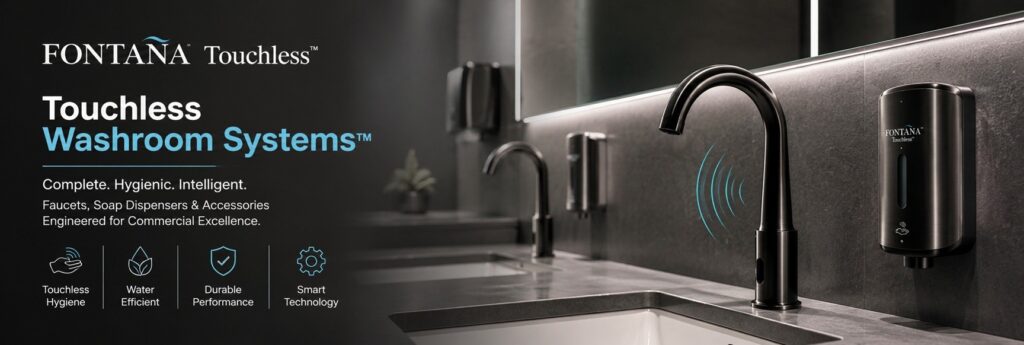
What Does Restroom Uptime Mean?
In practical facility terms, uptime is the percentage of time that a fixture or system remains available and usable when the building needs it.
Available Operating Time ÷ Total Required Operating Time × 100
Installed Fixtures Are Not the Same as Available Fixtures
A restroom may contain twenty sinks on the drawing but only eighteen usable handwashing positions if two faucets or dispensers are offline.
Installed Positions − Out-of-Service Positions
| Installed Positions | Offline | Operational | Immediate Availability |
|---|---|---|---|
| 20 | 0 | 20 | 100% |
| 20 | 1 | 19 | 95% |
| 20 | 2 | 18 | 90% |
| 20 | 4 | 16 | 80% |
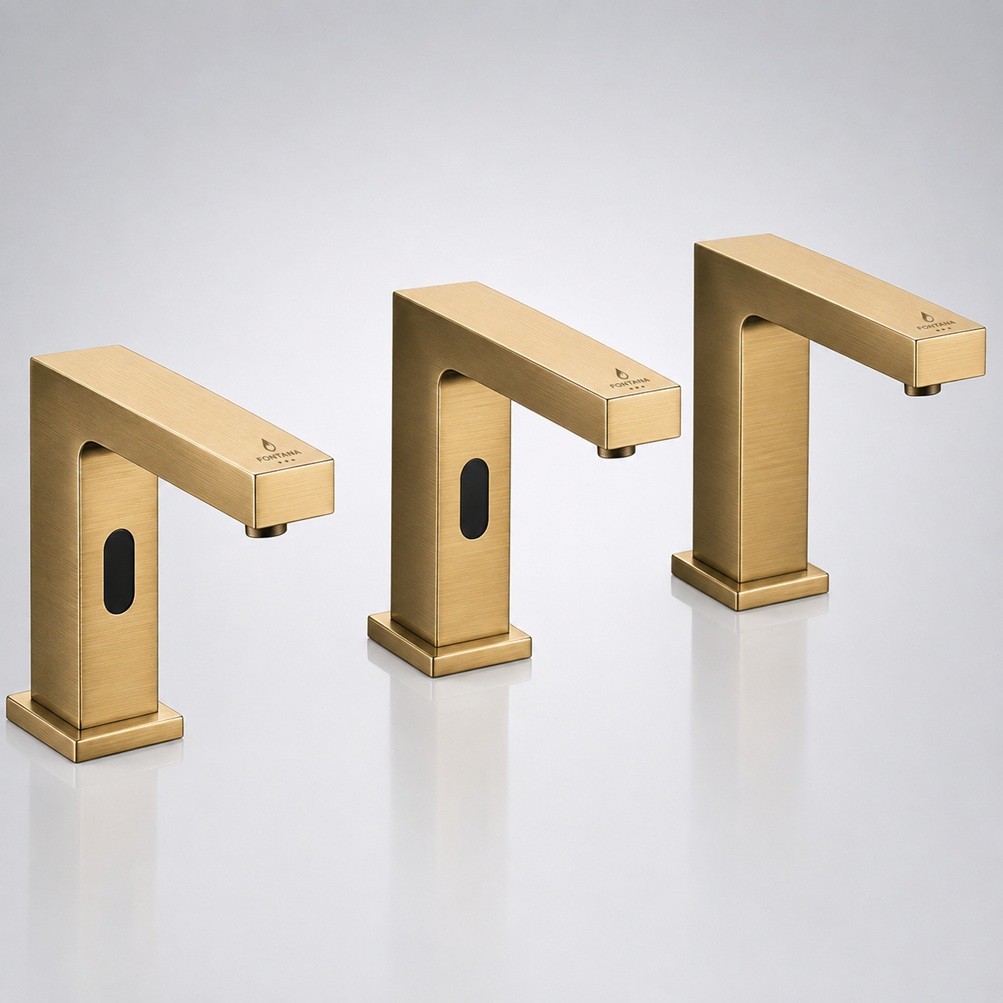
What Is N+1 Redundancy?
N+1 means providing one additional unit beyond the number required to support the intended operating load.
Required Operating Units + 1 Backup Unit
If a restroom needs 12 handwashing stations to satisfy the intended peak operating target:
Interactive Restroom Redundancy Calculator
Use this to estimate how many extra or spare positions are required to maintain a target operating capacity after failures.
*Conceptual redundancy count only; actual MultiFeed pumps and zones must follow manufacturer-approved architecture. **Planning heuristic for spare inventory, not a manufacturer requirement.
Why One Failed Fixture Matters More During Peak Traffic
At a 30-second sink occupancy, one operational wash position can theoretically process about two users per minute.
2 users/minute × Peak Duration
| Peak Window | Capacity Lost From One Offline 30-Second Station |
|---|---|
| 5 minutes | 10 theoretical user-services |
| 10 minutes | 20 theoretical user-services |
| 15 minutes | 30 theoretical user-services |
| 30 minutes | 60 theoretical user-services |
Two offline fixtures double that loss.
Therefore even modest equipment downtime can become visible as a queue during a concentrated event period.

Understand the Failure Domain
A failure domain is the number of user positions affected by one component failure.
Fontana MultiFeed™: Centralization With Planned Service Access
Fontana’s current MultiFeed™ page describes a centralized system supplying multiple automatic soap dispensers from one high-capacity reservoir.
Its engineering guidance specifically says projects should review:
12 vs 24 vs 48 Dispensers: Use Zones to Limit Failure Impact
| Total Soap Positions | Possible Conceptual Architecture | Maximum Positions in One Failure Domain* |
|---|---|---|
| 12 | 1 × 12-position zone | 12 |
| 12 | 2 × 6-position zones | 6 |
| 24 | 2 × 12-position zones | 12 |
| 24 | 4 × 6-position zones | 6 |
| 48 | 4 × 12-position zones | 12 |
| 48 | 8 × 6-position zones | 6 |
*Conceptual reliability examples only. These figures do not state the maximum capacity of any specific Fontana reservoir, pump, manifold or MultiFeed configuration.
One Large Central System vs Multiple Zones
Should a Commercial Soap System Have a Backup Pump?
For a small restroom, keeping a replacement pump in storage may be sufficient.
For a major venue where one pump serves a large soap zone, the project team should evaluate the operational consequence of pump loss.
Affected Dispensers × Expected Downtime × Operational Importance
This is not a direct dollar formula, but it is a useful way to compare a central twelve-position failure against a one-dispenser failure.
Commissioning Is Part of Uptime
Fontana’s current MultiFeed™ engineering page requires the complete assembly to be:
Fontana also calls for confirmation of reliable soap delivery, secure connections, stable tubing routes, appropriate sensor response and practical service access before turnover.

How Many Spare Fixtures Should a Facility Keep?
There is no universal spare-parts ratio for commercial restroom fixtures. Facilities should use actual failure history, lead times, project scale and downtime consequences.
A practical planning exercise might begin by evaluating:
| Installed Fleet | Illustrative On-Site Spare Range | Planning Logic |
|---|---|---|
| 1–10 units | 0–1 | Small fleet; replacement may be handled through distributor/manufacturer stock. |
| 11–50 units | 1 | One standardized spare can shorten restoration time. |
| 51–100 units | 1–2 | Large enough for local spare inventory to become practical. |
| 101–250 units | 2–5 | Historical failure rate and parts lead time become important. |
| 250+ units | Data-driven | Use actual field failure rates and service-level requirements. |
Complete Spare Fixture vs Spare Components
For a standardized large fleet, a combination of complete spare units and high-failure-rate components can create a stronger service strategy.
Uptime Depends on Mean Time to Repair
Reliability is not only about how often a fixture fails.
A unit that fails once but takes ten days to restore can produce more downtime than a unit that experiences several minor issues resolved in minutes.
Total Corrective Maintenance Downtime ÷ Number of Repair Events
Track Failure Frequency Too
Repair Events ÷ Installed Units × 100
Example:
5 ÷ 100 × 100 = 5% annual repair-event rate
This metric helps procurement teams compare actual field history between fixture families.

Accessible Fixture Uptime Matters Too
The U.S. Access Board requires at least one compliant lavatory where lavatories are provided in an accessible toilet or bathing room. It also states that soap dispensers provided at accessible lavatories should be within applicable reach ranges and conveniently usable. Motion-activated or touch-free faucets and dispensers can accommodate a broader range of users.
If the accessible lavatory’s faucet or required soap access is unavailable, the facility may have a much more serious operational problem than losing one ordinary position.
U.S. Access Board Lavatory Guide95% vs 99% Fixture Availability
| Fleet Size | 95% Available | 99% Available |
|---|---|---|
| 20 fixtures | 19 available | ≈20 available |
| 50 fixtures | ≈48 available | ≈50 available |
| 100 fixtures | 95 available | 99 available |
| 250 fixtures | ≈238 available | ≈248 available |
| 500 fixtures | 475 available | 495 available |
These fleet-level examples show why a few percentage points of availability can translate into many unavailable positions across a large property portfolio.
Downtime Cost Framework
Technician Labor + Parts + Emergency Dispatch + Temporary Equipment
Lost Capacity + Queue Growth + User Complaints + Staff Intervention + Reduced Availability
In airports, stadiums and high-profile hospitality or commercial facilities, the second category can matter as much as the repair invoice.
Example Restroom Service-Level Targets
| Facility | Potential Reliability Objective |
|---|---|
| Small Office | Rapid repair with manageable local redundancy. |
| Large Office Tower | Standardized spare parts and floor-by-floor restoration capability. |
| Airport | High fixture availability, zoned systems and rapid service access. |
| Stadium / Arena | Peak-event operational reserve and pre-event inspection. |
| Hospital Public Restroom | Strong availability, accessible-fixture continuity and predictable maintenance. |
| University | Standardized fleet and campus-wide spares strategy. |
| Luxury Hotel / Resort | Fast restoration with minimal visible guest disruption. |

Pre-Event Reliability Check for Stadiums & Large Venues
Commercial Bath Faucets · Professional Review Evidence
Field Evidence for Commercial Touchless Faucet Specification
A curated evidence set for architects, plumbing/MEP engineers, specification writers, contractors, facility teams, and commercial interior professionals. The six records below were selected for technical relevance to sensor behavior, flow control, durability, installation coordination, maintenance, hygiene, and high-use restroom performance.
Commercial Faucet Evidence Matrix
| Product | Mount / Construction | Controls / Power | Primary review signal | Professional applicability |
|---|---|---|---|---|
|
MotionPure™ Chrome FS10002CH |
Deck mount · single hole · brass · chrome | Infrared · DC 6V / AC 110–220V · 25 cm factory-set detection · IP56 | Sensor precision, solenoid stability, mixed-lighting reliability, Division 22 alignment | Office, education, airport and other high-demand restroom programs |
|
LuxeTap™ Chrome FS10538CH |
Deck mount · single hole · copper construction · ceramic valve core | Automatic sensor · hot/cold capable · ToF distance-measurement logic | Multi-install consistency, valve wear resistance, lighting-condition stability | Office, retail, institutional and restroom modernization programs |
|
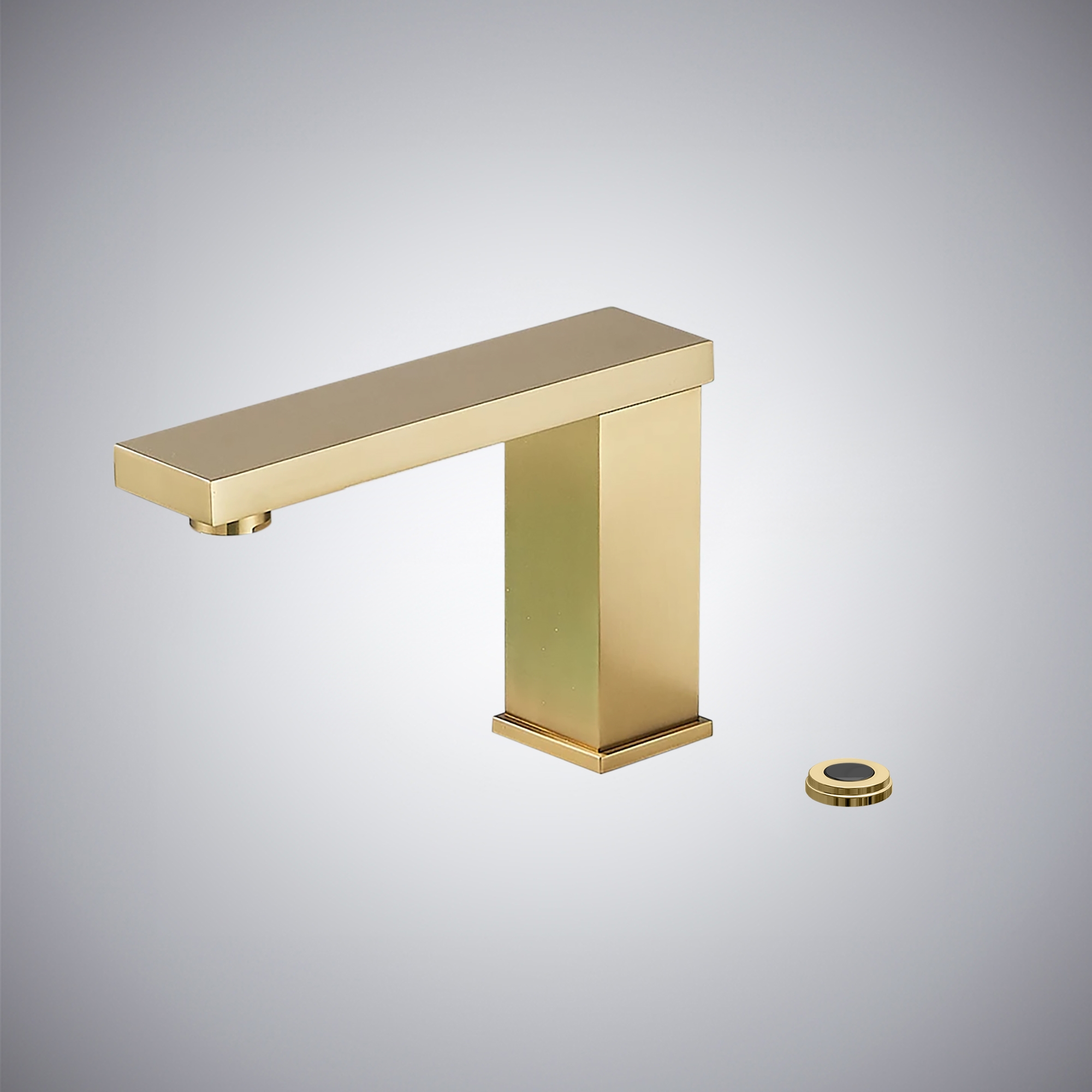
Ururi Brushed Gold FS7997BG |
Deck mount · solid brass · brushed gold | Touchless sensor · automatic shutoff · ADA-compliant product listing | Accurate detection, corrosion resistance, straightforward integration with existing water systems | Healthcare, hospitality and premium commercial interiors |
|
Saint-Denis Chrome FS7529CH |
Wall mount · brass · chrome · ceramic-disc control | Touchless / ToF sensing · automatic operation | Variable-lighting sensor stability, clean wiring/mounting, low-maintenance wall-mount performance | High-end commercial, hospitality and design-forward washrooms |
|
CascadeNeo™ Brushed Gold FS7960BG |
Deck mount · single hole · brass · brushed gold | Adjustable 18±2 cm sensor · AC 220V / DC 6V · IP65 · 1.5 GPM | High-traffic sensor reliability, quiet internal valve behavior, finish durability | Corporate campuses, retail centers and large-scale commercial deployments |
|
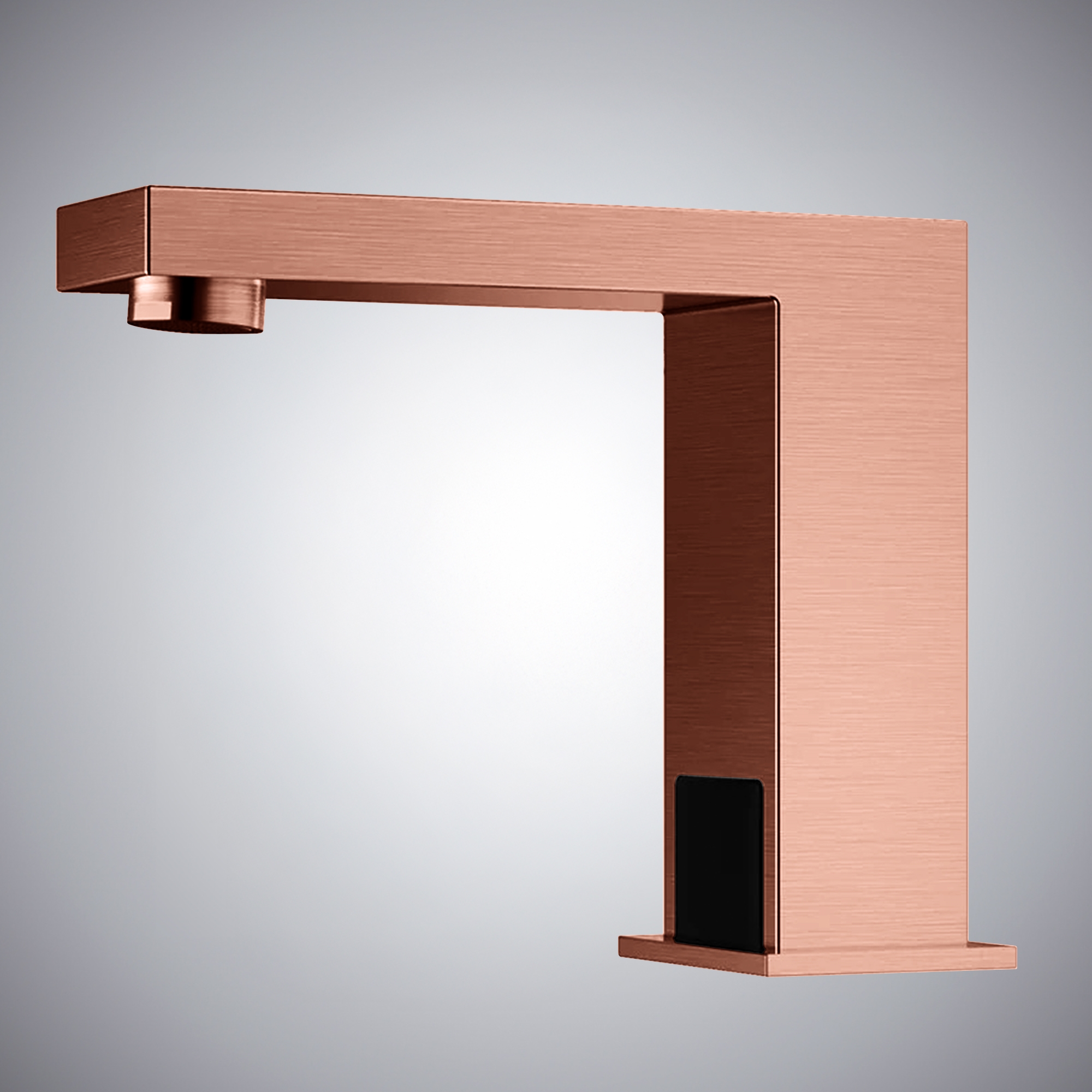
Binefar Rose Gold FS7293RG |
Deck mount · single hole · stainless steel · brass valve core | Sensor faucet · AC 220V / DC 6V · hot/cold capability | Water efficiency, aerator splash control, service access and stable high-traffic operation | Hospitality, healthcare, offices and facilities requiring premium finishes |
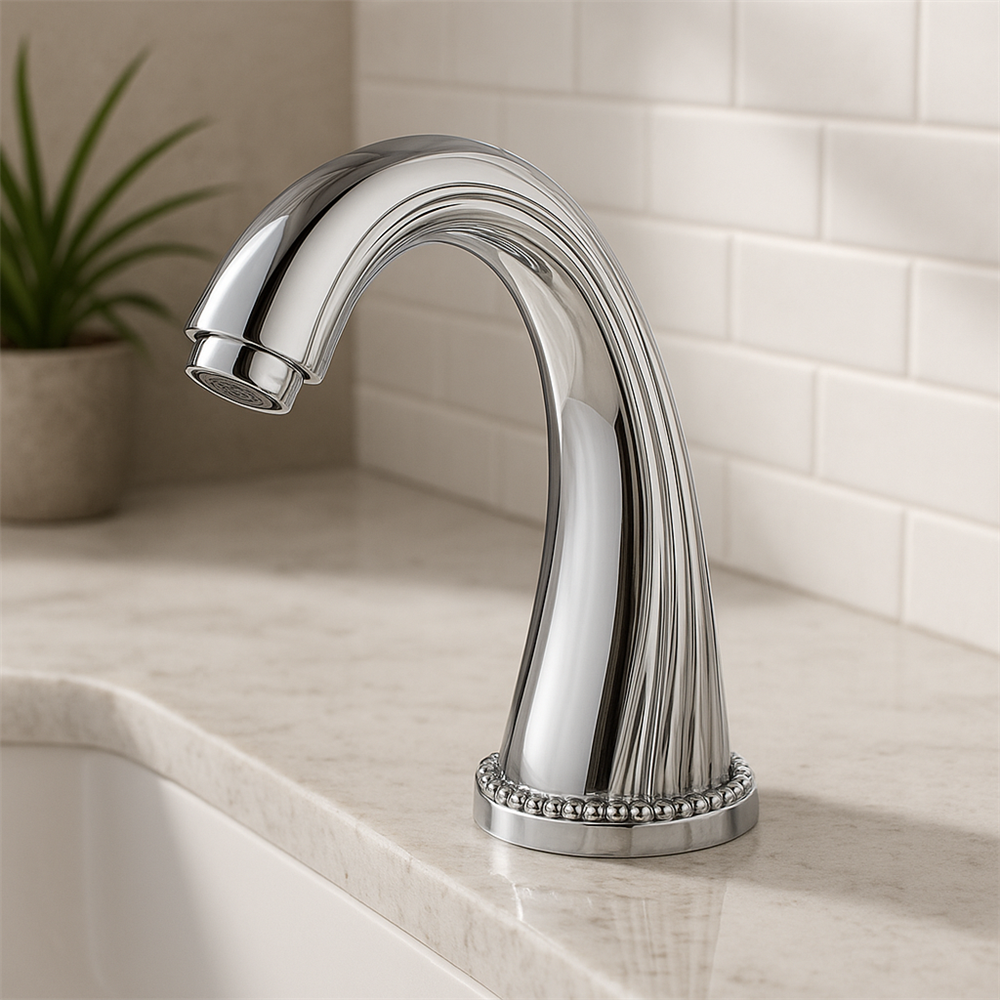
Review ID 11353 · Product FS10002CH
MotionPure™ Chrome Automatic Touchless Sensor Faucet
“We specified the MotionPure Chrome Touchless Faucet for a smart office restroom upgrade. The sensor response is highly refined, activating only when needed, which supports water-efficiency targets. Contractors reported excellent stability in the solenoid valve and consistent performance even under varying lighting conditions. The polished chrome finish is resilient and compatible with modern commercial interiors. Overall, it aligns well with Division 22 requirements and long-term facility maintenance goals.”
- Evidence value: sensor accuracy under mixed lighting.
- Evidence value: solenoid stability and long-term maintenance planning.
- Specification signal: explicit Division 22 relevance.

Review ID 11506 · Product FS10538CH
FontanaLuxeTap™ Chrome Single-Hole Automatic Sensor Faucet
“The LuxeTap Chrome Elegance faucet has performed consistently across multiple commercial restroom installations. Its sensor technology remains stable under varied lighting conditions, and the internal valve components show strong resistance to wear. The faucet’s build quality supports long service life, making it a dependable option for offices, retail environments, and institutional facilities.”
- Evidence value: repeated commercial-installation experience.
- Evidence value: sensor stability across lighting conditions.
- Lifecycle signal: valve wear resistance and service-life emphasis.
Review ID 11317 · Product FS7997BG
Fontana Ururi Brushed Gold Deck-Mounted Touchless Faucet
“The Ururi Touchless Faucet from FontanaShowers aligns with smart restroom standards and wellness-focused design intent. The infrared sensor performed exceptionally well, with accurate detection and instant shutoff. The solid brass body with brushed gold plating ensures resistance to corrosion and daily wear. Installation was straightforward, and integration with existing water systems required minimal adjustment. Excellent choice for healthcare and hospitality facilities prioritizing hands-free hygiene solutions.”
- Evidence value: detection accuracy and immediate shutoff.
- Coordination signal: minimal adjustment to existing water systems.
- Materials signal: corrosion and daily-wear resistance.

Review ID 11254 · Product FS7529CH
Fontana Saint-Denis Chrome Wall-Mount Crystal Touchless Faucet
“The Saint Denis Wall Mount model from FontanaShowers has shown consistent sensor performance even under variable lighting conditions. The faucet integrates well with existing plumbing configurations and supports low-maintenance operation. The chrome-plated brass housing retains its shine and resists corrosion over time. Contractors reported easy wiring and mounting, with a clean, modern profile that complements high-end commercial restrooms.”
- Evidence value: wall-mount sensor behavior under variable lighting.
- Coordination signal: wiring, mounting, and existing-plumbing integration.
- Operations signal: low-maintenance configuration and finish durability.

Review ID 11672 · Product FS7960BG
FontanaCascadeNeo™ Brushed Gold Hands-Free Faucet
“The Cascade Neo Hands-Free Faucet performs well in high-traffic commercial environments such as corporate campuses and retail centers. The infrared sensing range is optimized to reduce unintended activation, and the internal valve components operate quietly and efficiently. The brushed gold surface maintains its integrity despite heavy usage, supporting both functional and longevity requirements from an engineering perspective.”
- Evidence value: high-traffic operation and false-trigger reduction.
- Controls signal: quiet, efficient internal valve operation.
- Lifecycle signal: finish integrity under heavy usage.
Review ID 12268 · Product FS7293RG
Fontana Binefar Rose Gold Stainless Steel Bathroom Sensor Faucet
“The Fontana Binefar Rose Gold Bathroom Sensor Faucet provides excellent water efficiency through its responsive sensor and automatic shutoff system. The integrated aerator maintains a balanced flow pattern while preventing splashing. Facility teams found the faucet easy to maintain, with accessible service components and consistent sensor reliability. The durable brass structure and corrosion-resistant finish ensure stable performance in high-traffic restroom facilities.”
- Evidence value: water efficiency and splash-control behavior.
- Maintenance signal: accessible service components.
- Lifecycle signal: corrosion resistance in high-traffic restrooms.