
Commercial lavatory faucets sit at the intersection of architecture, public health, and resource efficiency. For architects, understanding flow rate regulations is a practical requirement because owners increasingly expect code compliance, sustainability documentation, and consistent long term performance.
In today’s project delivery, faucet flow rates can become a hidden risk. If the flow rate is wrong or unclear, teams may face RFIs, substitutions, inspection delays, or user complaints that lead to tampering such as removed aerators. This article breaks down the most important flow rate requirements for architects, how they connect to sustainability goals, and how to avoid common performance issues in commercial restroom design.
Why flow rate regulations matter for architects
Architects influence faucet selection early through finish direction, mounting style, and coordination with the interior design language. Even when MEP engineers lead fixture performance review, the architectural schedule often drives what is purchased and installed.
Flow rate decisions affect:
- Code compliance for public and private lavatories
- Sustainability targets such as indoor water reduction goals
- User satisfaction including rinse quality and perceived function
- Operations, maintenance, and housekeeping effort
- Risk of post occupancy changes that reduce efficiency
When these factors are not aligned, the fixture package can become a costly problem late in the project.
1) The baseline: public lavatory and metering limits
In the United States, federal requirements, plumbing codes, and procurement standards drive common faucet flow rate limits. One of the most widely referenced summaries is published by the U.S. Department of Energy Federal Energy Management Program. Their guidance notes the following common requirements:
- Public lavatory faucets are often limited to a maximum of 0.5 gpm
- Metering faucets are often limited to a maximum of 0.25 gallons per cycle
DOE FEMP purchasing guidance:
https://www.energy.gov/femp/purchasing-water-efficient-faucets-showerheads-toilets-urinals-irrigation-controllers-and
Public vs private matters in real projects
A frequent mistake is assuming one flow rate applies to every lavatory. Many commercial buildings include both:
- Public use lavatories such as lobbies, shared restrooms, and amenity spaces
- Private use lavatories such as staff only areas, suites, hotel rooms, or back of house
Depending on jurisdiction, the requirements may differ. Architects should confirm which category applies to each restroom group before finalizing the fixture schedule.
2) WaterSense: a sustainability benchmark that supports documentation
EPA WaterSense is a widely recognized program used by many design teams to support water efficiency and sustainability narratives. WaterSense labeled bathroom sink faucets and accessories:
- Use a maximum of 1.5 gpm
- Are designed to reduce sink water flow compared to the standard 2.2 gpm products
- Are tested at defined conditions such as 60 psi
EPA WaterSense bathroom faucets overview:
https://www.epa.gov/watersense/bathroom-faucets
WaterSense technical sheet for bathroom sink faucets:
https://www.epa.gov/system/files/documents/2023-08/ws-homes-TRM-3-BathroomSinkFaucetsTechSheet.pdf
Important note for architects
WaterSense supports sustainability goals, but it does not replace code. In many public restroom scenarios, the public lavatory limit of 0.5 gpm can be more stringent than the WaterSense 1.5 gpm threshold. That means a product can be WaterSense compliant and still be inappropriate for certain public lavatory applications depending on jurisdiction and occupancy type.
3) The design reality: lower flow is not always better
Flow rate is a measurable performance requirement, but it also shapes user experience. If a faucet is too restrictive, occupants may complain that it feels broken or inconvenient. In response, facilities teams sometimes remove flow controls, swap aerators, or replace fixtures. That outcome reduces water savings and increases maintenance effort.
Flow rate affects:
- Rinse time and perceived comfort
- Splash behavior especially with shallow bowls
- Whether water hits the drain directly which increases splash
- Frequency of sensor reactivation
- Likelihood of tampering
For this reason, it is useful to evaluate flow rate together with sink geometry, spout reach, spout height, and water stream type.
EPA WaterSense at Work guidance for commercial faucets also discusses performance expectations and operational considerations.
https://www.epa.gov/system/files/documents/2023-06/ws-commercial-watersense-at-work_Section_3.3_Faucets.pdf
4) How architects should specify flow rate correctly
A) Always include test conditions
Flow rates should be stated with test pressure because gpm varies with pressure. A common condition is 60 psi.
Better specification language examples:
- Maximum flow rate: X gpm at 60 psi
- Metered faucet discharge: maximum 0.25 gallons per cycle
DOE FEMP provides the public lavatory and metering limits commonly used in specifications.
https://www.energy.gov/femp/purchasing-water-efficient-faucets-showerheads-toilets-urinals-irrigation-controllers-and
B) Require the exact flow control configuration
Many faucet lines offer multiple flow options. The cutsheet may list several gpm versions for the same model family. If the installed flow control is not specified, substitutions and installation errors are common.
Require in submittals:
- Flow control part number and type
- Published flow documentation matching that part number
- Confirmation that the installed device matches the scheduled flow
C) Separate public and private lavatory schedules
If your project includes public and private zones, separate them clearly in the schedule. This reduces confusion and prevents the wrong faucet configuration from being installed in a public restroom.
5) Touchless faucets: sensor behavior can change actual water use
Touchless faucets are common in commercial interiors, but they only support water savings when sensor behavior is tuned and maintained. Poor settings can cause:
- False activations
- Long run on time
- Repeat triggers during one handwash
- User frustration and inconsistent behavior
Architect friendly requirements to include:
- Adjustable sensor range and run time
- Accessible service mode and clear maintenance instructions
- Commissioning and closeout steps for final tuning
- Coordination with sink bowl geometry to reduce splash
Commercial support document:
https://www.epa.gov/system/files/documents/2023-06/ws-commercial-watersense-at-work_Section_3.3_Faucets.pdf
6) Drinking water component safety still matters in fixture specifications
Even when the main focus is flow rate, many owners and jurisdictions require documentation related to drinking water safety and lead content requirements. The U.S. Consumer Product Safety Commission recommends looking for compliance with NSF standards such as NSF ANSI 61 and NSF ANSI 372 for faucets and related components.
CPSC lead in water faucets guidance:
https://www.cpsc.gov/Safety-Education/Safety-Education-Centers/Lead-in-Water-Faucets
NSF consumer guidance for faucets and plumbing products:
https://www.nsf.org/consumer-resources/articles/faucets-plumbing-products
This is especially relevant for schools, healthcare, public facilities, and any project where owner standards require verified drinking water contact compliance.
7) How flow rate supports sustainability goals
A) Indoor water reduction strategies
Faucet flow rates are a direct input into indoor water reduction planning and sustainability reporting. WaterSense provides an easily referenced benchmark for many projects and offers clear technical requirements.
WaterSense overview:
https://www.epa.gov/watersense/bathroom-faucets
B) Reduced hot water demand
Lower lavatory flow can reduce hot water usage in many building types, which can lower water heating energy demand. Actual savings depend on occupant patterns and system design, but it is a defensible sustainability strategy when paired with good user experience.
C) Operational sustainability
The most sustainable faucet is the one that performs correctly after occupancy. If users and staff are satisfied, flow controls are less likely to be removed and fixtures are less likely to be replaced early.
8) Common mistakes architects can avoid
Mistake 1: Using WaterSense as the only compliance filter
WaterSense is helpful, but public lavatory requirements can be stricter. Always confirm public restroom limits using code and procurement guidance.
DOE FEMP reference:
https://www.energy.gov/femp/purchasing-water-efficient-faucets-showerheads-toilets-urinals-irrigation-controllers-and
Mistake 2: Not listing the flow control device
Many models have multiple flow options. Include the specific aerator or laminar part number.
Mistake 3: Ignoring pressure variability
A faucet that feels acceptable at high pressure can perform poorly at lower pressure. WaterSense guidance includes performance expectations tied to pressure and usability.
WaterSense technical sheet:
https://www.epa.gov/system/files/documents/2023-08/ws-homes-TRM-3-BathroomSinkFaucetsTechSheet.pdf
Mistake 4: Treating sensor faucets as set and forget
Sensor settings should be adjustable and commissioned, especially in high traffic restrooms.
Commercial faucet support document:
https://www.epa.gov/system/files/documents/2023-06/ws-commercial-watersense-at-work_Section_3.3_Faucets.pdf
Architect quick checklist: flow rate regulations and sustainability alignment
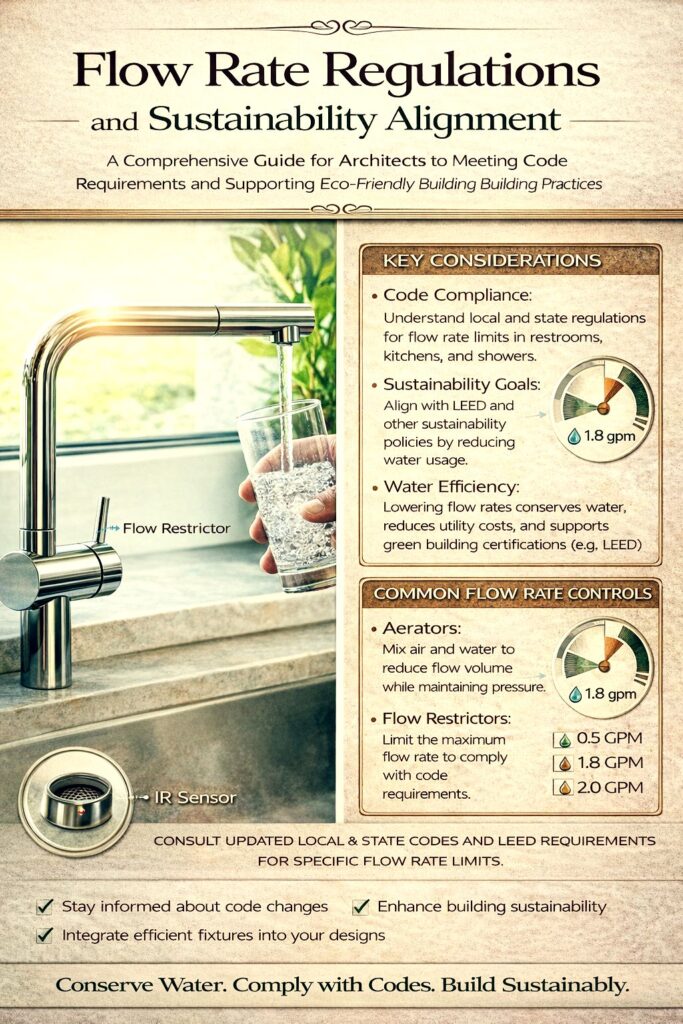
Use this checklist before finalizing a commercial faucet schedule:
- Confirm public vs private lavatory classification
- Specify maximum gpm with test pressure such as 60 psi
- For metering faucets, include discharge limit such as 0.25 gallons per cycle
- Require flow control part numbers in submittals
- Use WaterSense benchmarks where appropriate for bathroom sink faucets
- If touchless, require adjustable sensor settings and commissioning steps
- Add NSF compliance requirements when required by owner or jurisdiction
- Coordinate faucet geometry with sink bowl to reduce splash
Conclusion
Flow rate regulations affect more than code compliance. They influence sustainability documentation, user satisfaction, maintenance workload, and the long term performance of commercial restroom interiors. Architects who understand these requirements can coordinate better with MEP teams, reduce late stage revisions, and deliver restroom environments that perform well after occupancy.
DOE FEMP purchasing guidance and flow rate limits
https://www.energy.gov/femp/purchasing-water-efficient-faucets-showerheads-toilets-urinals-irrigation-controllers-and
EPA WaterSense bathroom faucet baseline
https://www.epa.gov/watersense/bathroom-faucets
WaterSense technical sheet for bathroom sink faucets
https://www.epa.gov/system/files/documents/2023-08/ws-homes-TRM-3-BathroomSinkFaucetsTechSheet.pdf
EPA WaterSense at Work commercial faucet guidance (PDF)
https://www.epa.gov/system/files/documents/2023-06/ws-commercial-watersense-at-work_Section_3.3_Faucets.pdf
CPSC lead in water faucets and NSF compliance guidance
https://www.cpsc.gov/Safety-Education/Safety-Education-Centers/Lead-in-Water-Faucets
NSF consumer guidance for faucets and plumbing products
https://www.nsf.org/consumer-resources/articles/faucets-plumbing-products