Commercial Restroom Plumbing Codes & Standards: How the Requirements Fit Together
Commercial restroom specifications are governed by several layers
of requirements. Building and plumbing codes control installation;
accessibility standards govern usable clearances and operable parts;
product standards establish fixture and fitting performance;
health-effects standards address potable-water materials; and
efficiency programs may add water-consumption criteria.
Commercial Restroom Codes — Quick Answer
Do not specify a commercial faucet, toilet, urinal, lavatory,
shower or touchless wash system from one standard alone.
First identify the locally adopted plumbing and building codes.
Then coordinate ADA accessibility, applicable product standards
such as ASME/CSA, potable-water requirements such as NSF/ANSI/CAN
61 and lead-content requirements, efficiency criteria, manufacturer
listings and project-specific owner requirements.
Determines legally adopted installation requirements.
Determines clearances, reach and operability.
Defines testing and fixture performance criteria.
Confirms model-specific compliance where required.
fixture performance, accessibility, plumbing codes, water efficiency,
power and service requirements.
Start With the Authority Having Jurisdiction
Published model codes are not automatically enforceable everywhere.
The legally applicable requirements come from the code edition,
amendments and regulations adopted by the project jurisdiction.
Jurisdiction
State, city, county or other authority adopts the enforceable code.
Model Code
IPC, UPC or another plumbing code forms the technical framework.
Accessibility
ADA plus applicable state or local accessibility requirements.
Product Standards
ASME, CSA, ASSE, NSF and referenced performance standards.
Project Specification
Owner, architect and engineer may require performance beyond code minimums.
Commercial Restroom Codes & Standards Matrix
| Reference | Primary Role | Typical Restroom Application | Specifier Action |
|---|---|---|---|
| ADA Standards | Accessibility | Lavatories, toilets, urinals, controls, accessories and clearances | Verify complete installed accessibility. |
| IPC | Model plumbing code | Fixture counts, water distribution, drainage and installation | Verify locally adopted edition and amendments. |
| UPC | Model plumbing code | Plumbing systems, fixtures, traps, water and drainage systems | Verify locally adopted edition and amendments. |
| ASME A112.18.1 / CSA B125.1 | Plumbing supply fitting standard | Lavatory faucets, metering fittings, shower fittings and supply stops | Verify model-specific listing / certification. |
| NSF/ANSI/CAN 61 | Drinking-water health effects | Faucets, valves and other potable-water components | Verify certified product where applicable. |
| Lead Content Requirements | Material safety / potable water | Potable-water fixtures and fittings | Verify applicable lead-content certification/documentation. |
| ASSE Standards | Specialized plumbing devices | Backflow, pressure regulation, temperature-control and safety devices | Identify standard applicable to each device. |
| EPA WaterSense | Water-efficiency labeling | Eligible toilets, urinals, private lavatory faucets and showerheads | Verify product category is actually eligible for labeling. |
code framework and the product standards used for model-specific review.
IPC vs UPC: Which Plumbing Code Applies?
The International Plumbing Code and Uniform Plumbing Code are
model codes. Project teams should never assume one automatically
governs a project based solely on geography or past practice.
ICC
International Plumbing Code
The IPC establishes minimum requirements for plumbing and related
piping systems, addressing health, safety, property protection
and system operation. Verify the adopted edition and local amendments.
IAPMO
Uniform Plumbing Code
The UPC addresses potable-water distribution, plumbing fixtures,
traps, drainage, vents, building drains and other plumbing systems.
The published code must still be adopted by the project jurisdiction.
Local Adoption
The AHJ Controls
States and municipalities can adopt model codes with amendments,
retain older editions or establish additional requirements.
Always establish the governing code basis at project start.
One Faucet Can Be Subject to Several Different Requirements
Adopted Plumbing Code
Installation, flow and system requirements
ADA / Accessibility
Reach, operability and clear floor position
ASME A112.18.1 / CSA B125.1
Supply-fitting performance standard
NSF / Potable Water Requirements
Health effects and material compliance where applicable
Project Requirements
Sensor, power, finish, flow, serviceability and owner standards
| Question | Reference Type |
|---|---|
| Can this faucet legally be installed here? | Adopted plumbing / building code |
| Can an accessible user operate it? | ADA / accessibility requirements |
| Has the fitting passed relevant product testing? | ASME / CSA product standard |
| Are potable-water-contact materials acceptable? | NSF / health-effects requirements |
| Does it meet owner water-use goals? | Project criteria / efficiency programs |
| Can the facility maintain it? | Owner specification / lifecycle criteria |
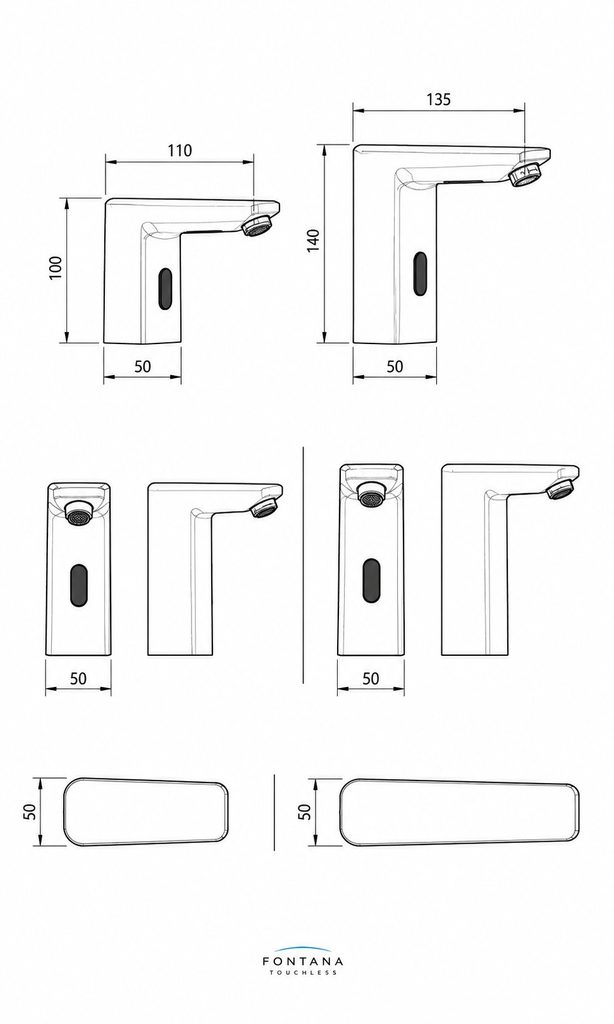
rough-in, basin geometry, accessibility and locally adopted code requirements.
ADA Requirements for Commercial Restrooms
The ADA Standards address the accessibility of the completed
facility. For restrooms, this includes clear floor space, turning
space, water-closet clearances, lavatories, faucet controls,
urinals, dispensers and other operable elements.
Clear Floor Space
Basic minimum clear floor or ground space where applicable.
Lavatory
Maximum front rim/counter height for accessible lavatories.
WC Clearance
Minimum water-closet clearance under the applicable arrangement.
Metering Faucet
Minimum open time for hand-operated metering faucets.
Commercial Restroom ADA Coordination Matrix
| Element | ADA Design Concern | Engineering Coordination |
|---|---|---|
| Lavatory | Height, clear floor space, knee/toe clearance | Basin, counter, trap and supply location |
| Faucet | Controls must satisfy operability requirements | Control geometry, sensor position and basin relationship |
| Water Closet | Centerline, transfer clearance and flush controls | Partitions, wall thickness and plumbing location |
| Urinal | Accessible fixture where required | Rim height, clear floor space and flush control |
| Soap Dispenser | Operable / activation point within reach | Counter depth and user hand position |
| Hand Dryer | Accessible operable position | Mounting height and circulation |
| Exposed Pipes | Protection from contact | Trap, supply valves, insulation and protective covers |
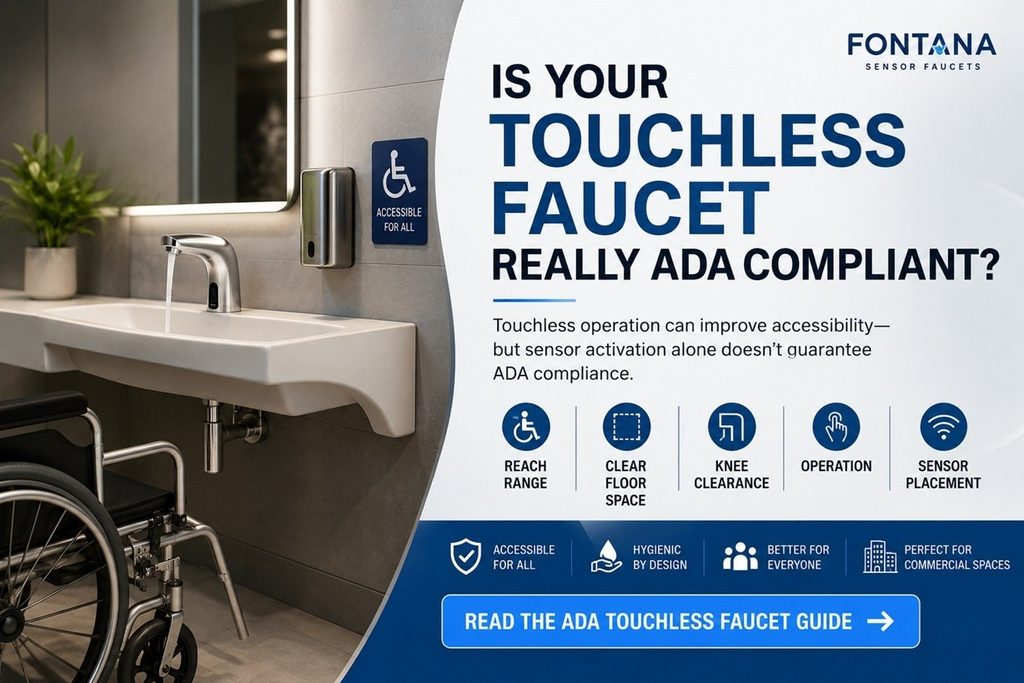
fixture operation and correct lavatory geometry.
not simply the dispenser housing height.
ASME A112.18.1 / CSA B125.1 and Commercial Faucets
ASME A112.18.1/CSA B125.1 is a major plumbing-supply-fitting
standard covering categories including lavatory supply fittings,
metering and self-closing fittings, bath and shower fittings,
showerheads, hand showers and supply stops.
| Product | Typical Standard Relevance | Specifier Check |
|---|---|---|
| Commercial Lavatory Faucet | Plumbing supply fitting | Verify certification/listing and exact model. |
| Touchless Faucet | Supply-fitting performance plus electronic controls | Verify fitting standard and sensor/power documentation. |
| Metering Faucet | Metering / self-closing supply fitting | Coordinate product testing with ADA open-time requirement. |
| Shower Valve | Bath/shower supply fitting; compensating valve requirements may apply | Verify applicable valve standard and temperature-control requirements. |
| Showerhead | Supply fitting / spray performance requirements | Verify rated flow and applicable efficiency criteria. |
| Supply Stop | Plumbing supply fitting | Confirm listed component and accessible service location. |
supply fitting standards, electronic controls, accessibility,
potable-water requirements and project-specific performance criteria.
NSF/ANSI/CAN 61 and Potable-Water Components
NSF/ANSI/CAN 61 addresses health effects for components used in
drinking-water systems. Its scope includes plumbing devices such
as faucets as well as valves, filters, pipes, joining materials
and other water-system components.
Health Effects
NSF/ANSI/CAN 61
Evaluate products in contact with potable water for applicable
health-effects requirements and model-specific certification.
Lead Content
Lead-Free Verification
Do not infer lead-content compliance from finish or body material.
Use applicable certification and manufacturer documentation for
the exact model.
Certification
Model Specific
A manufacturer’s participation in a certification program does not
automatically establish certification for every model or configuration.
Verify the actual listed product.
Touchless Faucets Add Requirements Beyond Conventional Plumbing
The plumbing fitting still must satisfy applicable plumbing
requirements, but the finished system also introduces sensor,
power, wiring, solenoid and commissioning considerations.
| Touchless Component | Code / Standard Concern | Project Requirement |
|---|---|---|
| Faucet Body | Applicable plumbing supply-fitting requirements | Material, finish and mounting |
| Sensor | Product-specific electronic/control documentation | Detection range and false-trigger performance |
| Solenoid | Water-control component | Pressure range and service accessibility |
| Power Supply | Applicable electrical requirements | Battery, low-voltage, hardwired or hybrid architecture |
| Mixing Valve | Applicable temperature-control / plumbing standard | Set point and service location |
| Commissioning | Project quality-control requirement | Sensor, flow, shutoff, water landing and fault testing |
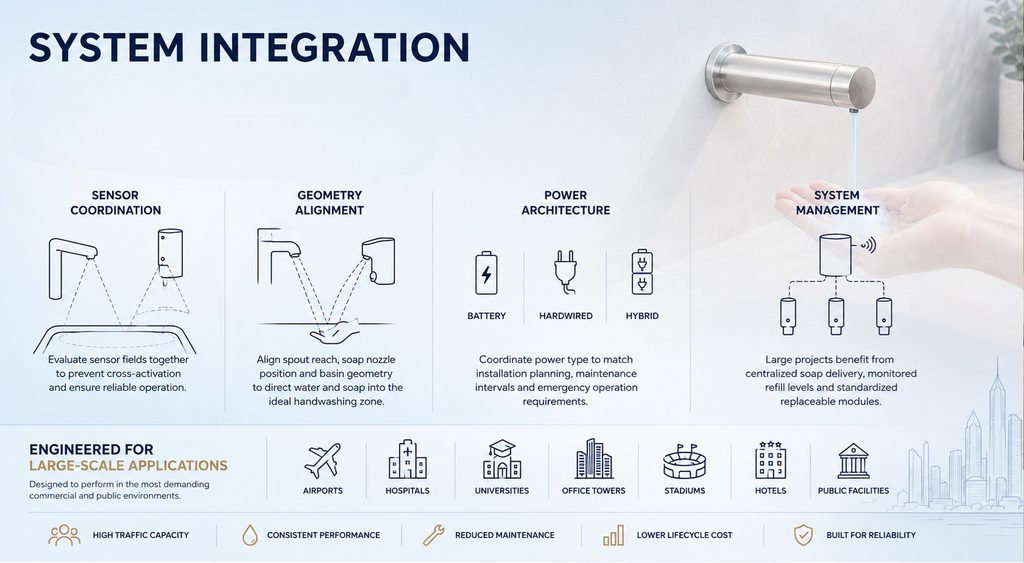
controls, water delivery, soap delivery and accessibility considerations.
WaterSense: Know Which Commercial Fixtures Are Actually Eligible
WaterSense is not a universal label for every low-flow plumbing
fixture. The eligible product category must be confirmed before a
project schedule or marketing claim identifies a fixture as WaterSense labeled.
Public Lavatory
EPA describes this as a typical efficient/code-level flow, but public lavatory faucets do not currently have WaterSense labeling criteria.
Commercial Toilet
Maximum WaterSense flush volume for eligible flushometer-valve toilets.
Commercial Toilet
WaterSense minimum flush volume for flushometer-valve toilets.
Showerhead
Maximum flow for WaterSense labeled showerheads.
| Fixture Category | WaterSense Status | Important Specification Note |
|---|---|---|
| Public Lavatory Faucet | No current WaterSense labeling criteria | Do not call a public faucet WaterSense labeled solely because it is 0.5 GPM or lower. |
| Private Lavatory Faucet | Eligible category | Confirm exact certified model/accessory and current specification. |
| Flushometer-Valve Toilet | Eligible category | WaterSense maximum 1.28 gpf and performance requirements apply. |
| Flushing Urinal | Eligible category | Verify exact WaterSense-certified model. |
| Showerhead | Eligible category | WaterSense maximum flow is 2.0 gpm with performance criteria. |
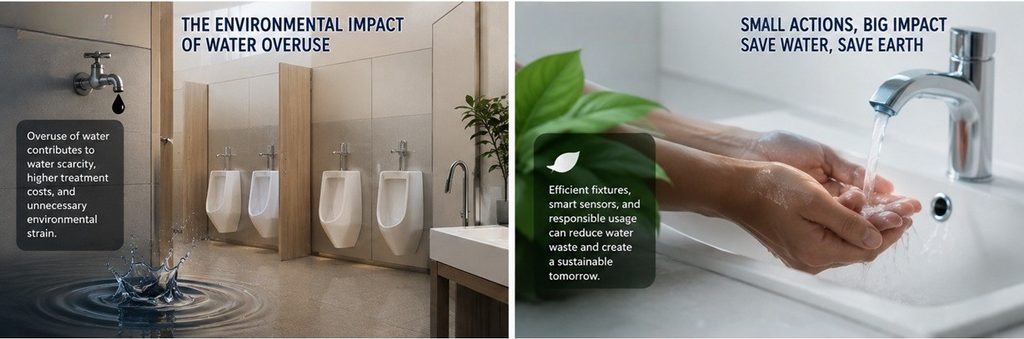
certification so teams do not confuse a low flow rate with a certification label.
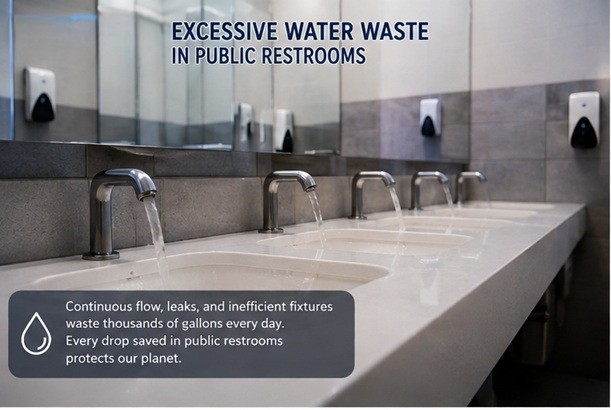
maintenance and actual fixture traffic.
ASSE Standards: Backflow, Pressure & Temperature-Control Devices
ASSE publishes standards for specialized plumbing products,
including backflow-prevention devices, pressure-reducing valves,
water-hammer arresters and automatic compensating valves.
The applicable standard depends on the actual device used in the system.
| Device Type | Why It Matters | Specifier Action |
|---|---|---|
| Pressure-Reducing Valve | Controls excessive building pressure | Verify applicable standard, pressure range and location. |
| Backflow Prevention | Protects potable-water system | Select device based on hazard and code requirement. |
| Water-Hammer Arrestor | Controls hydraulic shock | Coordinate with fast-closing valves and system design. |
| Automatic Compensating Valve | Controls shower temperature | Verify applicable ASSE/ASME/CSA standard and adjustment. |
| Thermostatic Mixing / Tempering Device | Controls delivered water temperature | Identify exact device standard and intended application. |
Commercial Restroom Fixture-to-Standard Map
| Fixture / System | Code Review | Product Standard Review | Accessibility Review | Efficiency Review |
|---|---|---|---|---|
| Touchless Faucet | IPC / UPC as adopted | ASME/CSA + potable-water requirements | ADA operability + lavatory geometry | Public-lavatory flow requirement |
| Manual Faucet | IPC / UPC as adopted | ASME/CSA + potable-water requirements | ADA operable parts | Flow requirement |
| Lavatory | IPC / UPC | Applicable fixture standard | ADA 606 | — |
| Commercial Water Closet | IPC / UPC | Applicable fixture / flush-valve standards | ADA 604 | WaterSense where applicable |
| Urinal | IPC / UPC | Applicable fixture / valve standards | ADA 605 where required | WaterSense where applicable |
| Shower | IPC / UPC | ASME/CSA + applicable valve standards | ADA 608 where accessible shower required | WaterSense showerhead where specified |
| Soap Dispenser | Accessory / project requirements | Model-specific electrical/product documentation | Reach + operability | Soap-use strategy |
or sustainability criteria above the baseline plumbing-code requirements.
Commercial Restroom Code & Standards Checklist
Every product should be checked against the code basis and the
exact technical requirements of the project rather than accepting
a generic statement that a fixture is “code compliant.”
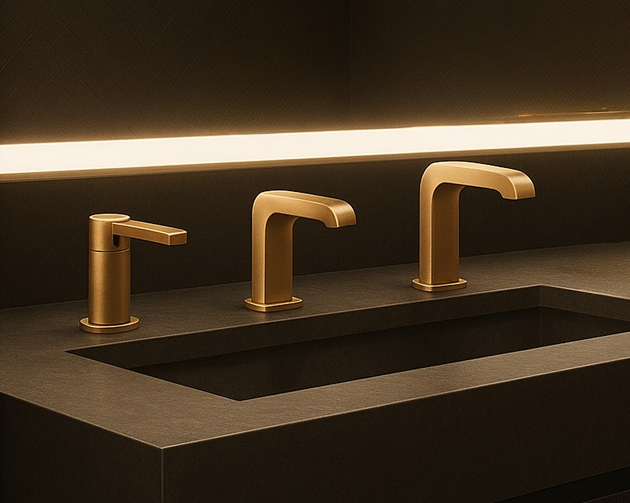
repeated fixture while also coordinating basin spacing, sensors and service access.
Code-Compliant Products Still Need Commissioning
A listed or certified product can still perform poorly if installed
incorrectly. Field commissioning verifies that the assembled system
matches the project documentation and performs as intended.
| Field Test | Verify | Reason |
|---|---|---|
| Sensor Activation | Correct detection zone | Prevent false or missed activation. |
| Automatic Shutoff | Reliable valve closure | Control water use and fault conditions. |
| Flow | Specified outlet performance | Confirm water-efficiency basis. |
| Temperature | Delivered water temperature / mixing | Confirm project safety and comfort requirements. |
| Accessibility | Reach, clearances and operability | Verify completed installation—not design intent only. |
| Backflow / Specialty Devices | Installation orientation and accessibility | Support proper device performance and testing. |
| Service Access | Valves, filters, solenoids, batteries and panels | Avoid lifecycle maintenance conflicts. |
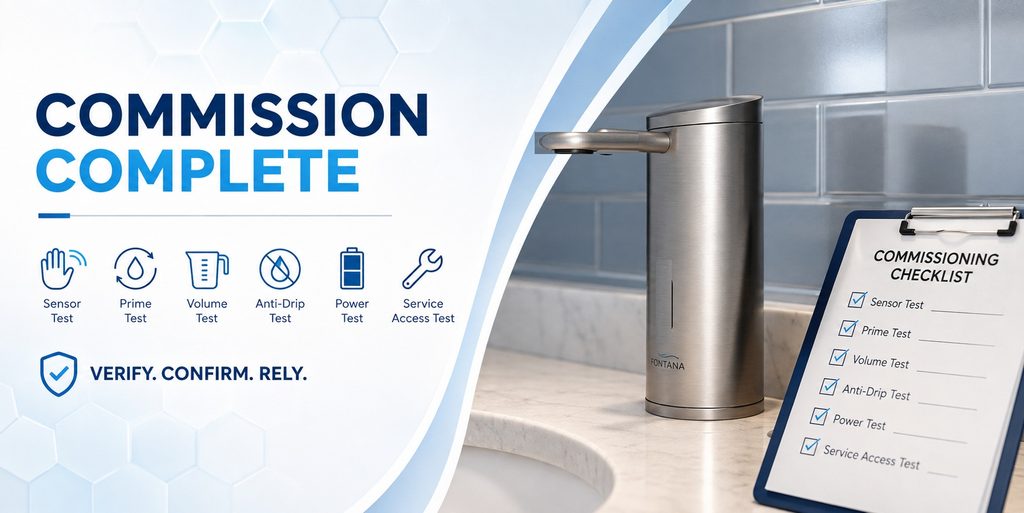
and the actual installed restroom system.
Codes Establish the Minimum—Facility Type Can Require More
Healthcare
Clinical Requirements
Healthcare facilities may add infection-control, water-management,
laminar-flow, maintenance or owner standards beyond baseline plumbing code.
Airports
High-Traffic Reliability
Airport restroom specifications may add lifecycle cycling,
remote monitoring, vandal resistance and rapid service requirements.
Hotels
Guest + Public Areas
Private guest-room bathrooms and public hotel restrooms can fall
into different faucet efficiency categories and accessibility conditions.
Education
Durability + Age Groups
Schools may require child-specific accessibility dimensions in
applicable areas plus durable institutional fixture standards.
Stadiums
Peak Demand
Fixture count, peak-flow demand, drainage capacity and fast service
access become particularly important during event loading.
Office Buildings
Standardization
Large portfolios benefit from consistent faucet, valve, power and
replacement-part standards across multiple floors and properties.
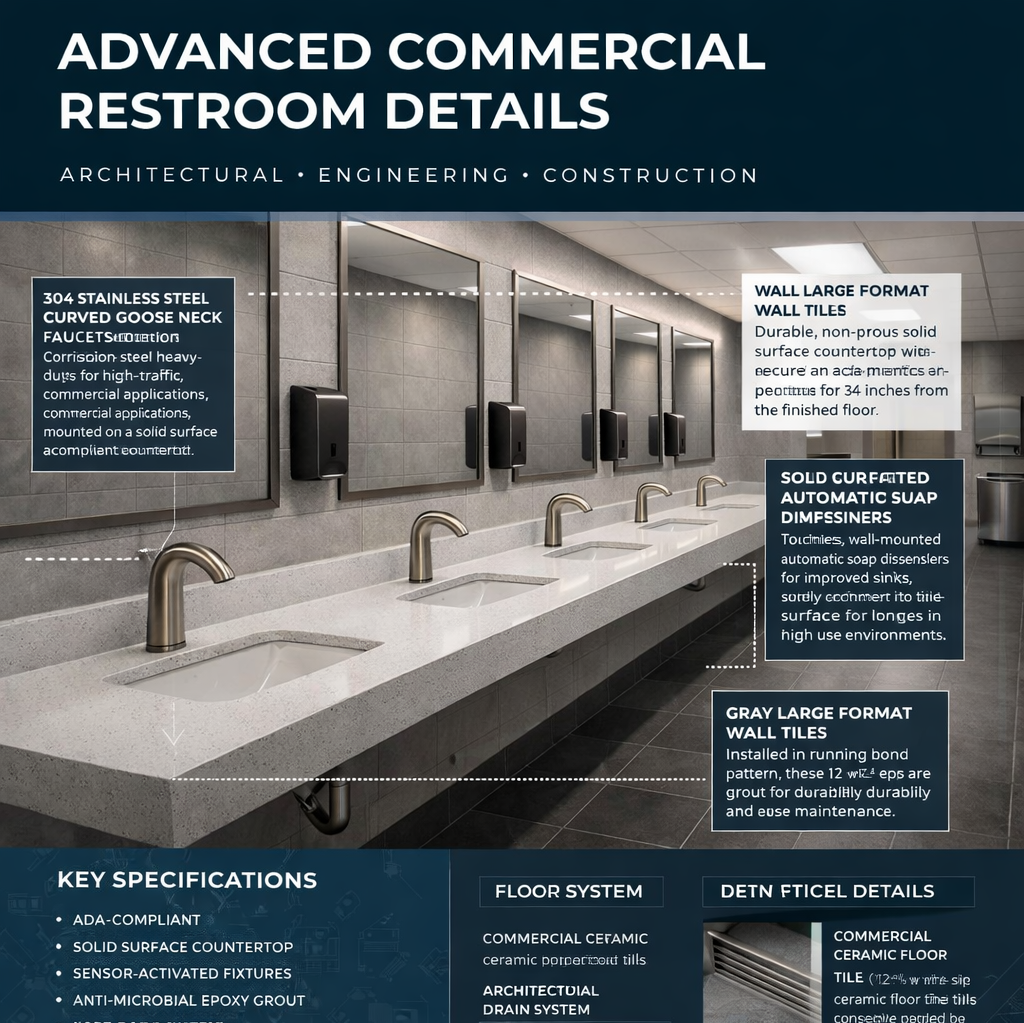
higher traffic, serviceability or lifecycle reliability justify stronger criteria.
Commercial Restroom Plumbing Code Questions
Which plumbing code applies to a commercial restroom?
The applicable plumbing code is the edition adopted by the project’s
authority having jurisdiction, including local amendments.
Do not assume the latest IPC or UPC automatically governs the project.
What is the difference between IPC and UPC?
Both are model plumbing codes covering plumbing-system design and
installation. The IPC is published by the International Code Council,
while the UPC is developed by IAPMO. The applicable code depends on
jurisdictional adoption.
Does ADA replace the plumbing code?
No. ADA accessibility requirements and plumbing-code requirements
operate together. A restroom fixture may satisfy the plumbing code
yet still be inaccessible if reach, clear floor space, fixture
location or operability does not comply.
What standard applies to commercial bathroom faucets?
Commercial lavatory faucets commonly fall within plumbing
supply-fitting standards such as ASME A112.18.1/CSA B125.1.
Potable-water health-effects and lead-content requirements may
also apply, along with the locally adopted plumbing code.
Does NSF/ANSI/CAN 61 apply to faucets?
NSF/ANSI/CAN 61 includes plumbing devices such as faucets within
its scope for drinking-water-system component health effects.
Always verify the exact certification required by the jurisdiction
and the certification status of the submitted model.
Are 0.5 GPM public restroom faucets WaterSense labeled?
Not automatically. EPA currently does not have WaterSense labeling
criteria for public lavatory faucets. EPA notes that public lavatory
faucets typically use 0.5 GPM or less for efficiency and plumbing-code
purposes, but that is different from earning a WaterSense label.
Can commercial toilets earn the WaterSense label?
Yes. WaterSense has a specification for flushometer-valve toilets.
Eligible labeled units use no more than 1.28 gallons per flush and
must meet EPA performance requirements.
What is the ADA maximum height for an accessible lavatory?
The front of the higher of the lavatory rim or counter surface is
34 inches maximum above the finished floor under ADA Section 606.3,
subject to applicable exceptions.
How long must an accessible metering faucet remain open?
ADA Section 606.4 requires hand-operated metering faucets to remain
open for at least 10 seconds.
Do touchless faucets automatically satisfy ADA requirements?
No. Automatic operation can simplify operability, but the completed
lavatory must still satisfy applicable accessibility requirements,
including clear floor space, knee/toe clearance and usable sensor location.
What is the difference between code compliance and certification?
A code sets requirements for the building or installation.
A product standard defines testing or performance criteria.
Certification provides third-party evidence that a specific product
meets a referenced standard. All three concepts can apply to one fixture.
Should code references be listed in the fixture schedule?
Yes, where useful. At minimum, the project should maintain a code
basis and identify relevant product standards and certifications.
Avoid filling schedules with generic logos or certifications that
have not been verified for the exact submitted model.
How should architects review plumbing fixture substitutions?
Compare the proposed substitute against mounting, dimensions,
flow or flush volume, power, product standards, accessibility,
certifications, finish, sensor performance, serviceability and
replacement support—not just appearance and purchase price.
Technical & Code Notice
This article is an engineering and specification reference, not a
substitute for the adopted code or professional code analysis.
Plumbing-code editions, state amendments, local accessibility
requirements and product-certification requirements vary by
jurisdiction. Always verify the current adopted code, approved
product documentation and requirements of the authority having
jurisdiction before final design, bidding or installation.
Code → Standard → Product → Installation
Compliance Is a Chain, Not a Logo on a Cut Sheet
A strong commercial restroom specification begins with the adopted
code, applies accessibility requirements, identifies the correct
product standards, verifies model-specific certifications and then
checks the final installation in the field. When those steps are
connected through the fixture schedule, submittal review and
commissioning process, architects and engineers can reduce both
code risk and long-term operational problems.